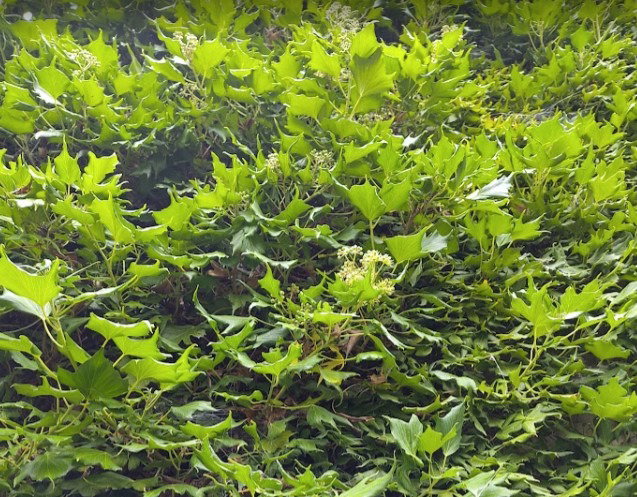
IVY on trees – Friend or FOE?
Monday, 12 October 2026
The Royal Horticultural Society (RHS) says
'Maligned and misunderstood, ivy is often accused of strangling plants. While it may need controlling to keep it in check, particularly where it creeps into borders, ivy doesn't directly harm trees and is a fantastic plant for wildlife'.
Why is ivy so important to wildlife?
Ivy is evergreen. It provides hiding places, roosting space, and also hibernating places for a wide range of insects, small mammals and birds.
Dunnocks, robins, wrens and flycatchers all like to nest in ivy.
As a food source, it feeds caterpillars, butterflies and moths.
In autumn, the ivy flowers are a fantastic food source for large numbers of pollinators.
Walking along Rothbury riverside the other day I had to stop, listen, and look in great pleasure! The buzzing was incredible! All sorts of insects hungrily feeding on the pollen and nectar, when so little else is available.
After the flowers, come lovely dark berries, which have a high fat content. A valuable food for many birds, including waxwings, starlings, finches, thrushes and blackbirds.
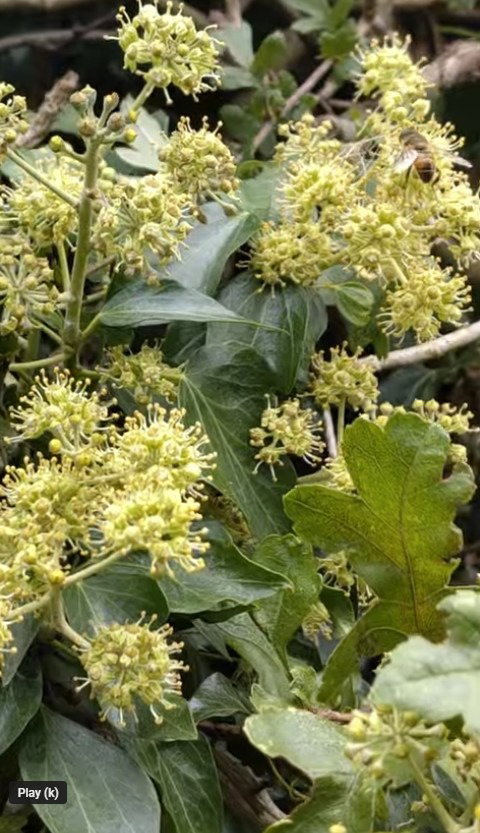
Above is a still from a very short video of the ivy flowers on Rothbury Riverside.
Is ivy harmful to trees?
That trees are badly harmed by ivy growing up them is very common misconception. A quick look on the internet throws up all sorts of You Tube videos where tree experts show us how to kill the enemy - ivy.
However, if we look at what the trusted experts say, they all appear to agree that ivy growing on trees is not normally a problem to the tree.
There are instances when it might be necessary to remove it, though.
Possibly on very young trees, if they are about to be smothered and the ivy will stop the young tree from photosynthesising.
On weak, or old, or damaged trees, ivy growth might make inspection difficult. Also, the extra weight of the ivy can make branches unstable and liable to fall in windy conditions.
RHS answers: Do I need to get rid of ivy?
"No - allowing ivy to grow in a wildlife area, woodland, less-cultivated area or along and among a mature hedge is a great way to attract wildlife and boost the biodiversity of your garden.
Ivy is a valuable garden plant as it tolerates challenging conditions, such as deep shade and dry soil, where many other plants would struggle to grow”
The Woodland Trust tells us:
Ivy (Hedera helix and Hedera hibernica).
Clingy, luscious, misunderstood. Ivy has long been accused of strangling trees, but it doesn't harm the tree at all, and even supports at least 50 species of wildlife.
Does ivy kill trees?
Ivy uses trees and walls for support, allowing it to reach upwards to better levels of sunlight. It is not a parasitic plant and has a separate root system in the soil and so absorbs its own nutrients and water as needed.
Ivy does not damage trees and its presence doesn't indicate that a tree is unhealthy.
'Is ivy the most divisive plant in Britain'?!
We can leave the last words, and pictures, to Molly Blair, in Gardens Illustrated. Molly asks, 'Why do we hate ivy? The truth about whether it damages walls and why we need to change of view of this helpful plant'.
Molly's article looks at the pros and cons of Ivy.
But to conclude this short discussion, we can sum up by saying that Ivy is, like many other plants and animals, often wrongly maligned.
Mostly, ivy is not an enemy to trees, and it is certainly a friend to wildlife.
As discussed, sometimes it does need to be removed, but not as a matter of course.