
Guest Story: Michael Boxall tells us about his hedge in May
Wednesday, 27 May 2026
Spring marches on and the blackthorn blossom is over. It remains to be seen if the flowers have been fertilised and will develop into sloes: they do most years, but the majority last year were small, probably due to lack of rain. I don't want a wet summer, but would like sufficient, preferably at night, to keep everything green and growing.
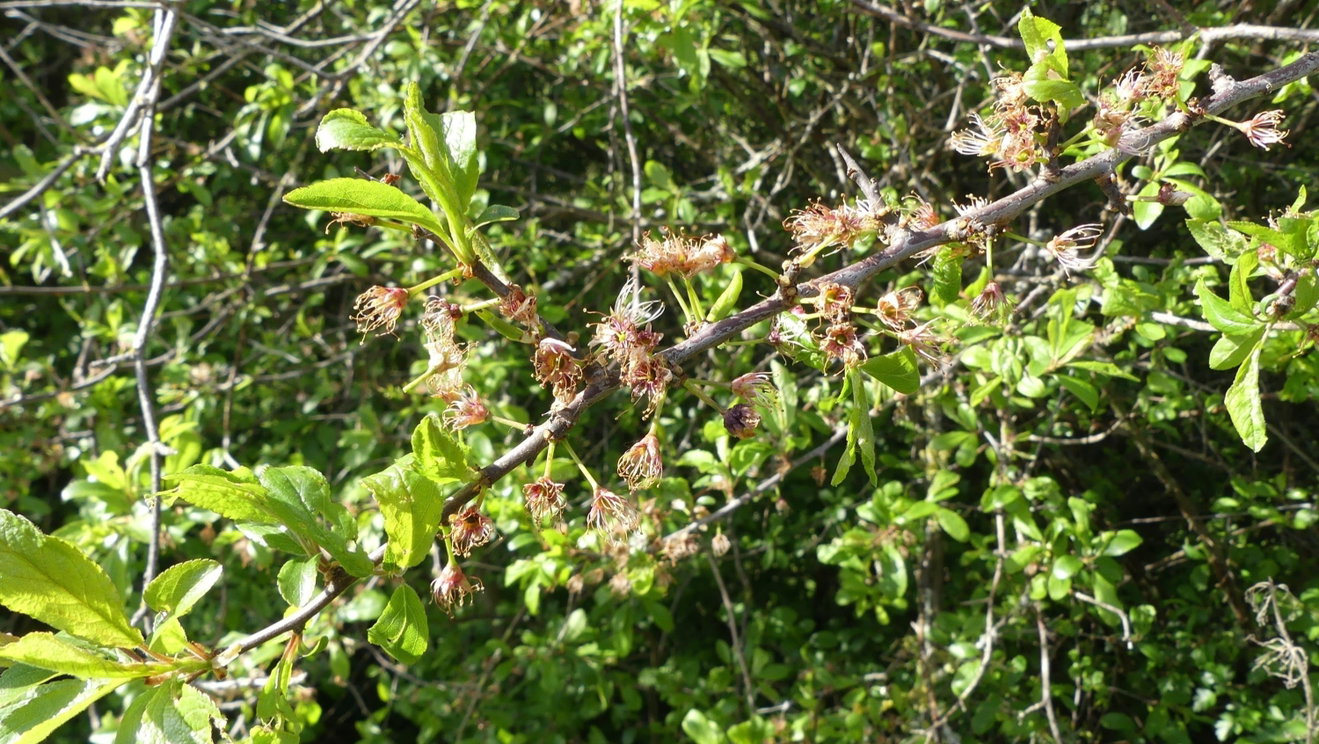
Spent blackthorn blossom
While some of the mature hawthorns on the embankment are in flower, those along the hedge are being a little tardy and as of today (May 6th) show only swollen buds which are becoming whiter by the day: their musky scented beauty still to burst forth. Some people don't like the heavy scent, but I do: it is one of later springs' delights, though only at a distance: sniff the flowers closely and they do smell rather unpleasant.
The hedge itself might offer little by way of pollen or nectar at the moment, but there are plants growing up in the rough beside the bushes that do: white dead nettle is very attractive to bumblebees such as this Common Carder Bee. These bees get their name from their habit of gathering moss to build their nests on or just under the ground.
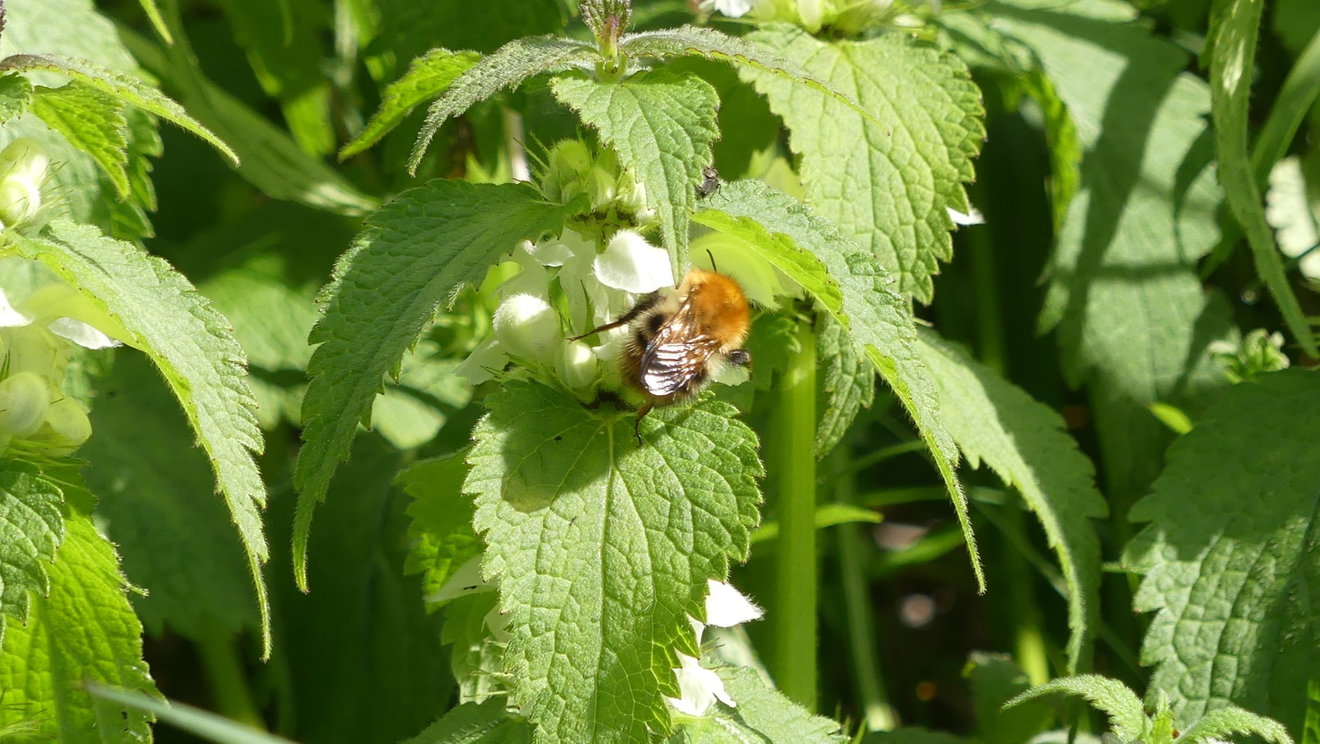
Common Carder Bee
These flies may not be taking advantage of the cafe available beneath their feet, but are making full use of the broad flat leaves to sunbathe well sheltered from the wind.
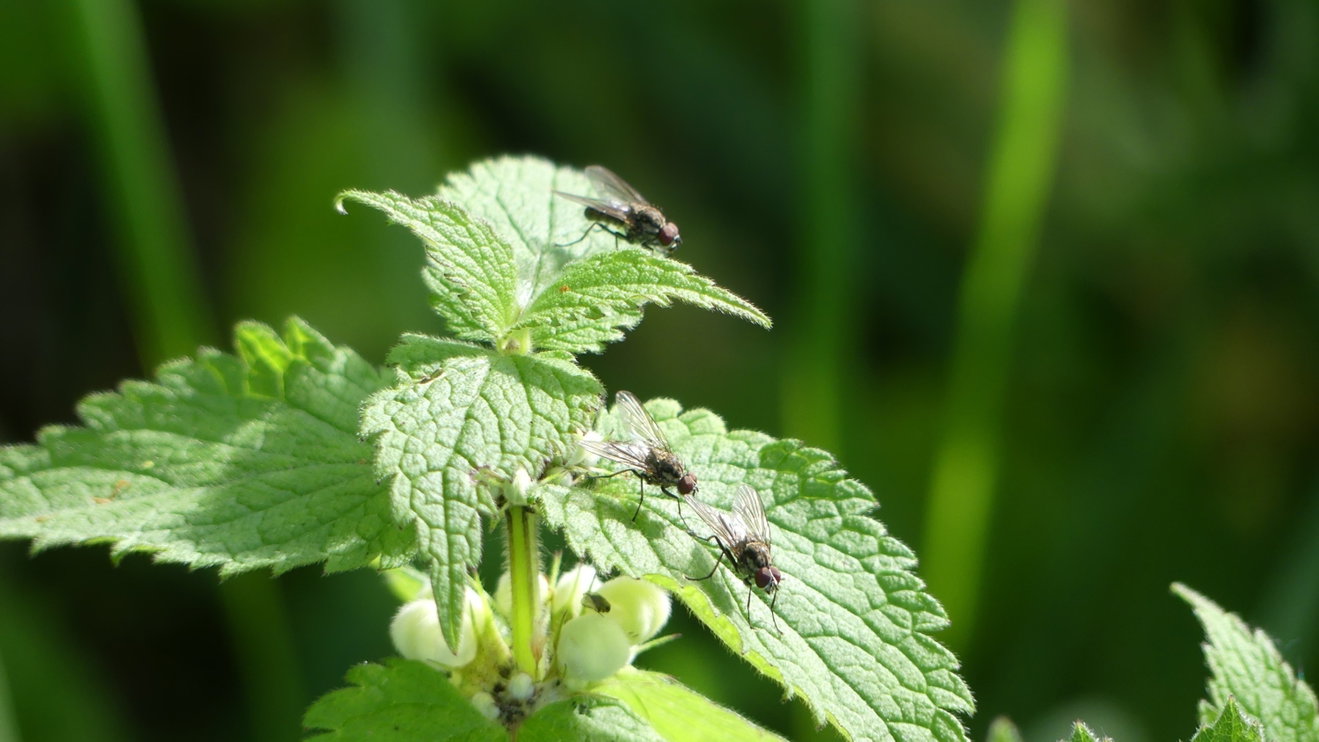
Flies sunbathing
The middle of the month has been unseasonally chilly, with a number of frosts and these decidedly cool conditions have reduced insect activity.
Black, hairy, long legged St Mark's flies, so named because their appearance coincides roughly with that saint's day, swarm along the hedge in parts sheltered from the wind, but only when the sun shines, disappearing almost instantly when a cloud obscures him. These are the male flies dancing, hoping to attract females sitting in the vegetation below to join them and mate, which from those I have seen do so on the bushes or solid ground. Some unfortunates have chosen the road surface and fallen victim to passing vehicles. Their larvae live in the soil where they do some damage to roots, but are unlikely to trouble the hedge.
Note that there are at least two species of lichen on the hawthorn branch beside the fly.
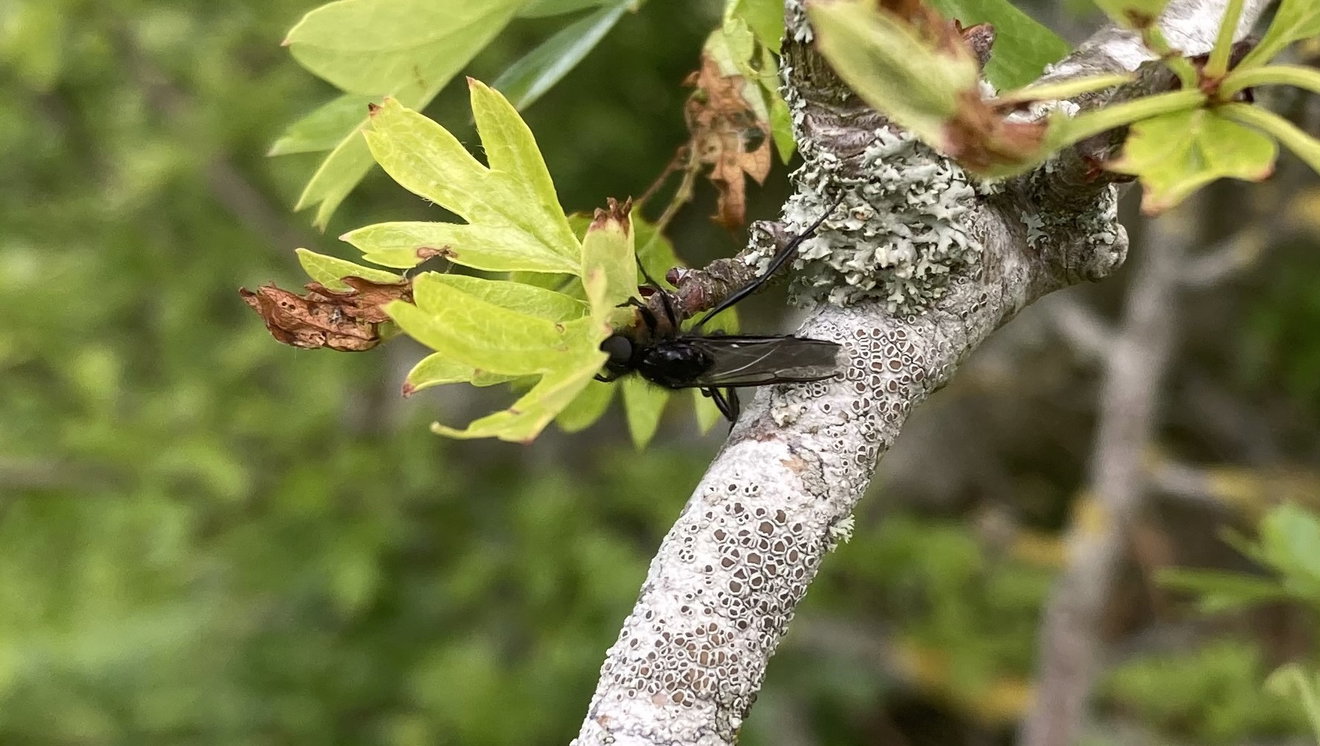
A St Mark's Fly
With the bushes now in full leaf it is difficult to see anything going on within the hedge, and vegetation growing up along both sides makes an impenetrable screen at ground level, but it is still possible to see evidence of some comings and goings.
Rabbits have regular runs between their burrows and feeding areas and these create narrow pathways through the low vegetation beside the hedge, easily overlooked but clearly visible when you know what you are looking at.
Some of the grass beside the one in the photo has been eaten down by them, which shows they didn't need to venture far from cover to feed and therefore would have been able to disappear almost instantly if something threatening appeared.
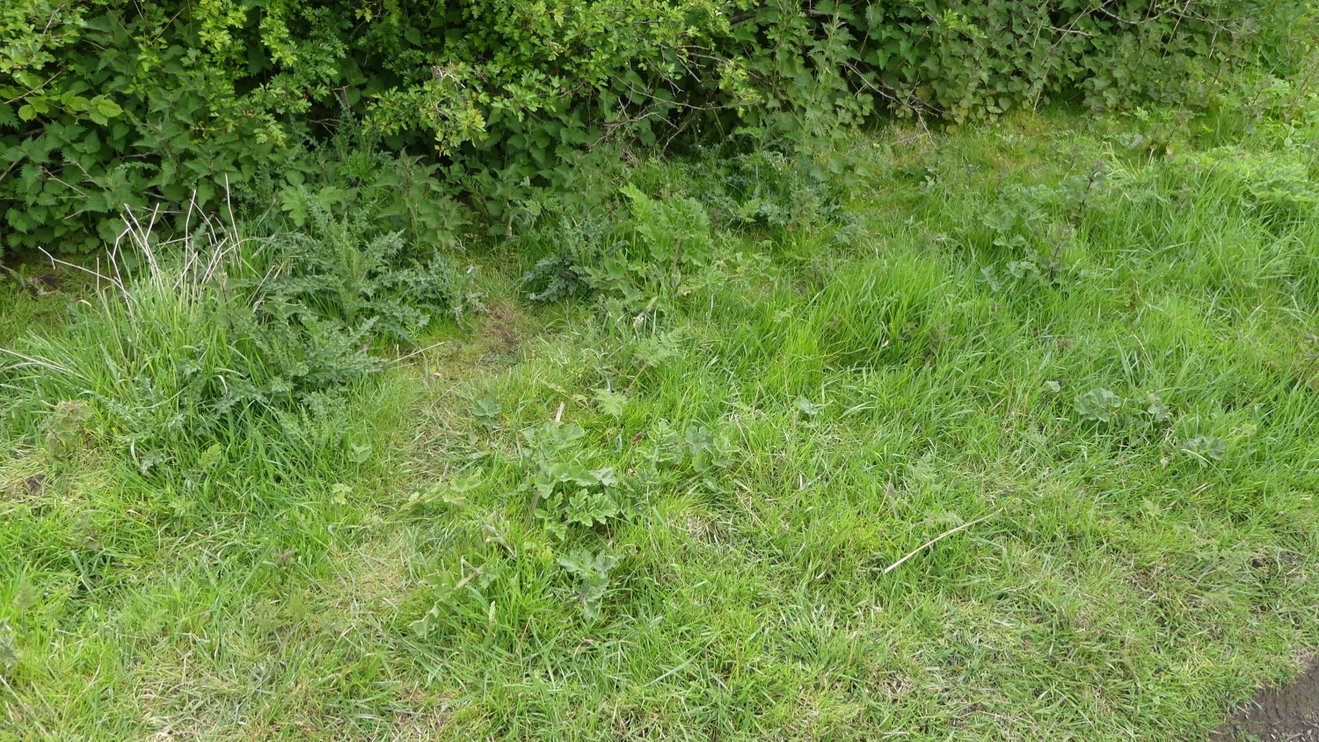
Rabbit trail into the hedge.
Feeding of a different kind is taking place on a few of the blackthorns: leaves at the tip of some shoots are becoming distorted and heavily crumpled. This is the work of sap sucking aphids and, according to my wife, who has faced the same trouble on plum and damson trees in our garden (blackthorn is a member of the same family), may possibly be because the bushes are under stress due to a lack of water, rendering them more vulnerable to attack: certainly competition for soil moisture must be intense along the hedge.
However, I don't expect this will be a serious problem for them and the aphids will provide food for insect eating birds or possibly ladybird larvae.
With the middle of the month now past the hawthorns are finally coming into flower, though in a rather more drawn out fashion than blackthorn and don't therefore present quite such a spectacle.
May and Whitethorn are alternative names for hawthorn, but no-one knows for sure if the old saying ' n'er cast a clout till May be out' refers to its first flowers opening, or the end of the month. Certainly, with the unseasonally chilly weather we've had recently I would concur with those who think the latter.
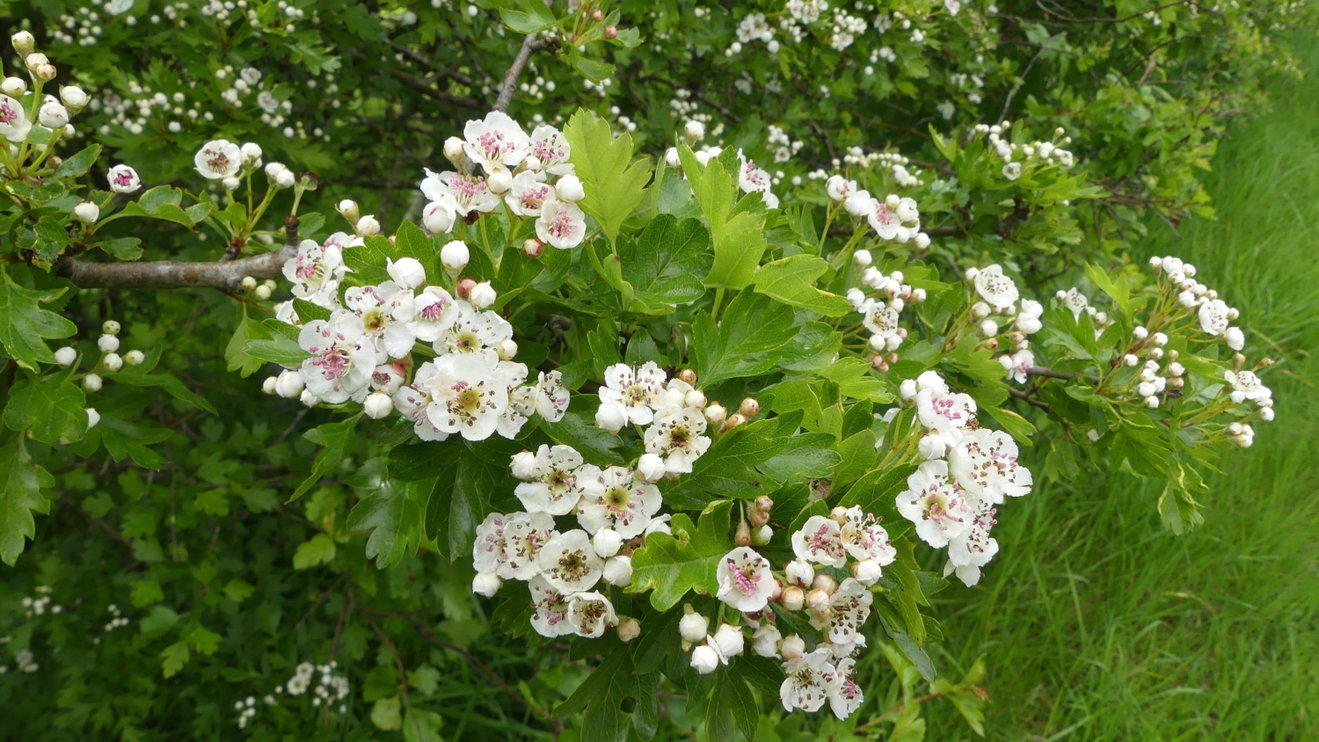
Hawthorn blossom.
It is worthwhile spending a few minutes looking at a spray of hawthorn flowers: you will be surprised how many species come to them, for nectar, pollen and simply as somewhere to perch. I did so this morning and in addition to flies large and small a green veined white butterfly also dropped in to refuel on nectar. Look closely at the photo and you can see its long proboscis curving down into a flower.
They are called 'green veined' because of the lines of dark green/black scales alongside the wing ribs: the small white, whose caterpillars can ruin your cabbages, don't have them. These lay eggs on garlic mustard and other members of the cabbage family, but tend not to bother gardeners nearly as much.
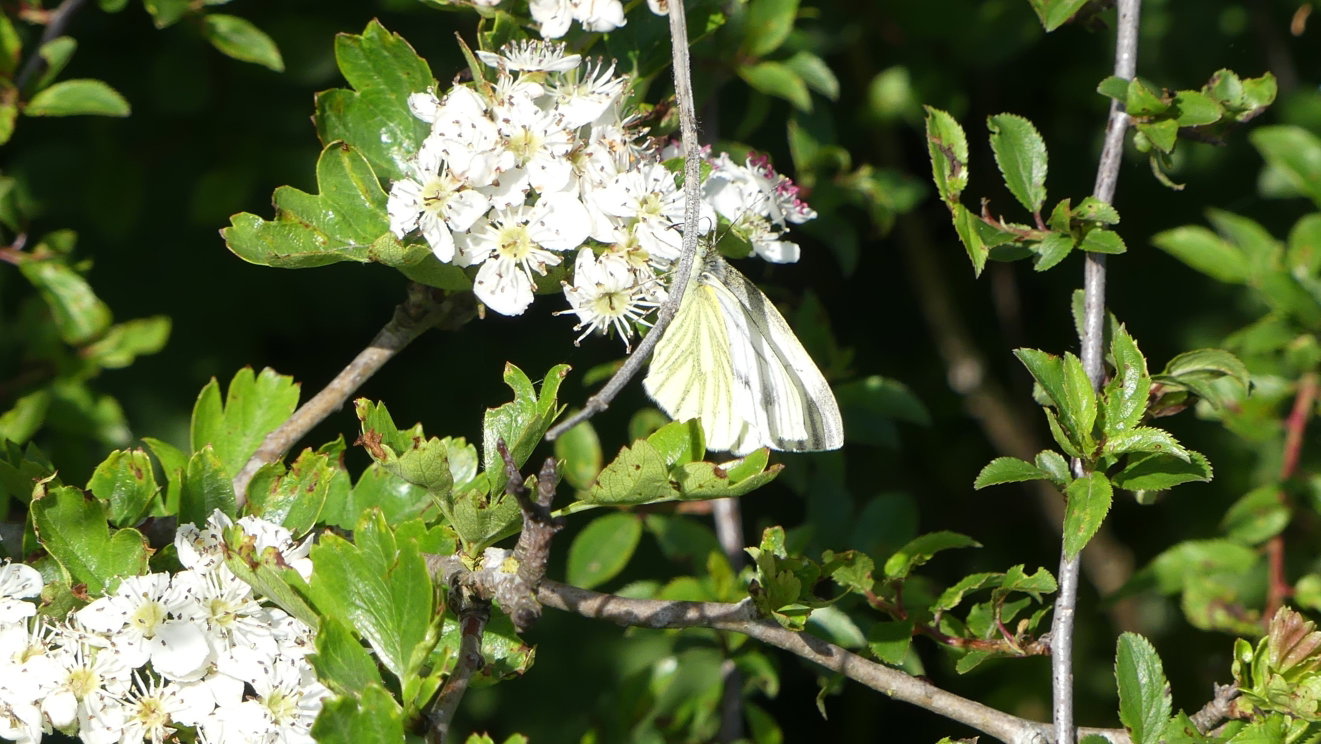
A green veined white, nectaring.
I cycled to my patch this morning (25th) before the worrying burst of extreme heat Britain is suddenly being subjected to built up too much. I heard several whitethroats singing in hedges along the way: they have just arrived from Africa but as yet the pair who nested in my hedge last year haven't done appeared. I really hope they will in the next few days.
In past years they have joined yellowhammer, chiff-chaff and most surprising, one year, a sedge warbler. This is in addition to the regular chaffinch, tits, dunnock and robin, but today only the willow warbler was singing, though I did also hear a brief snatch of the merry, rather tinny notes of a blackcap.
Maybe, at half past ten it was already too hot for them.
At the start of the month I was wondering if the blackthorn flowers had been fertilised, and indeed it was no surprise to find they have: small sloes are developing. All they need now is plenty of rain to help them swell, but it doesn't look as though we can expect much in the near future.
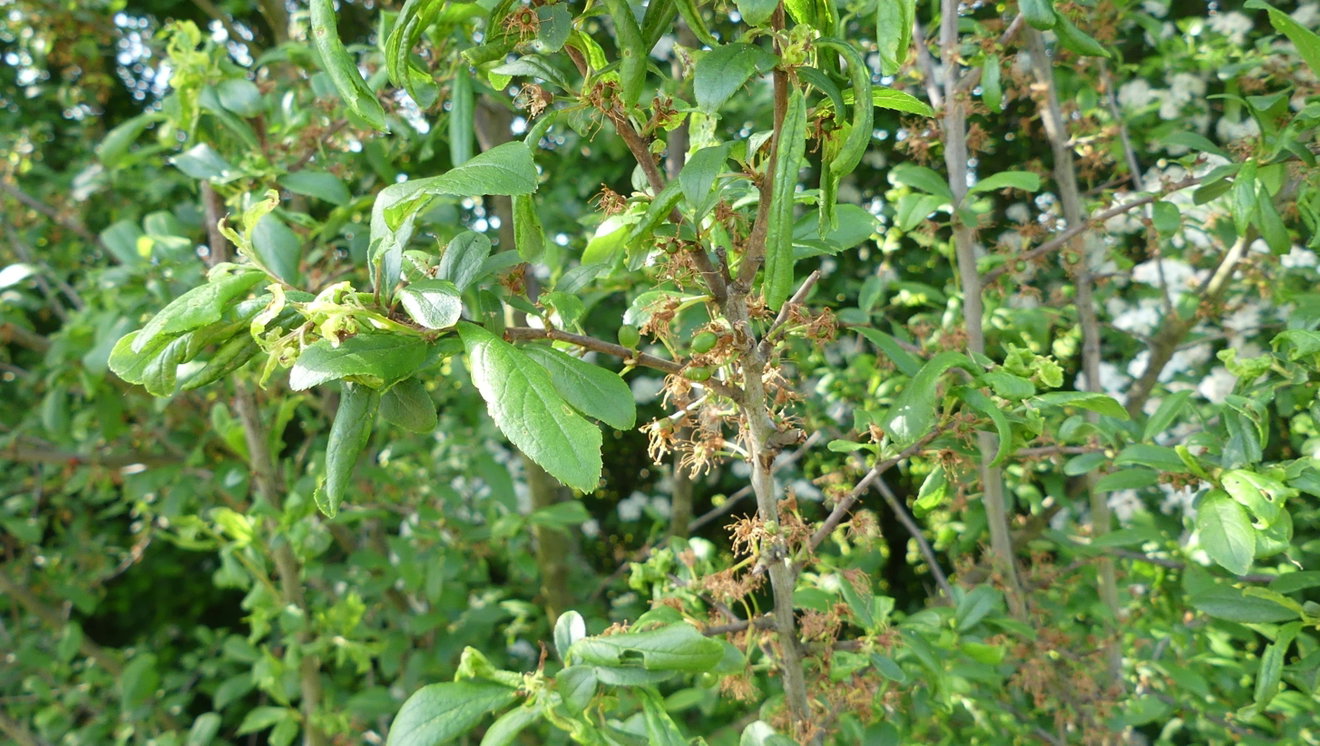
Developing sloes